

The Methods of Service
Section 88 of the Residential Tenancy Act (the “act”) sets out the various ways in which documents may be served between parties to a residential tenancy. Generally, documents may be served using the following methods:
Personally handing it to the other party;
Leaving it with the landlord’s agent (if serving the landlord);
Ordinary or registered mail;
Leaving it with an adult who apparently resides with the other party;
Placing it in the mailbox or mail slot;
Attaching it to the person’s front door or other conspicuous place (usually called “posting to the door”);
Sending it by fax to the number given by the person as a fax number for service;
Emailing it to the person’s email address given for service.
All parties should ensure that they use only approved methods for serving documents. Certain methods are not permitted for the service of documents. These include:
Text message;
Slipping documents under the door;
WhatsApp, Facebook Messenger, or other messaging apps;
Social media direct messages; or
Sending to an email address not provided by that person for the purpose of serving documents.
Despite the general rules of service, certain documents may only be served using particular methods. For example, a landlord’s 10-Day Notice to End Tenancy may not be served by posting to the tenant’s door. Landlords and tenants alike should carefully review the rules specific to the documents they are serving, including any detailed instructions provided to them by the Residential Tenancy Branch to ensure compliance with the relevant rules for their matter.
It’s important to note that only those methods outlined in the Act and the Regulations are recognised means of service. Other ways of sending documents are not valid forms of service. For example, sending the documents by text message is not a recognised means of service, so documents should never be sent this way by either party.
Timelines and Deadlines
Each method of service is deemed to be served in a specific number of days after being sent, often referred to as the “deemed served rule”. These specific timelines are set out below:
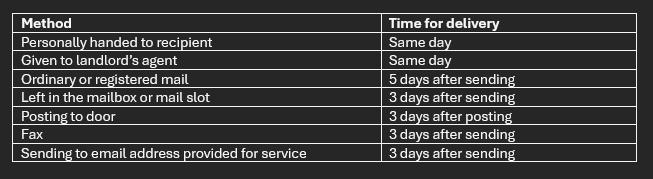
There are particular deadlines in relation to scheduled hearings by which applicants and respondents must serve their evidence. Generally, an applicants’ evidence must be served at least 14 days prior to a scheduled hearing, whereas respondents must serve their evidence at least 7 days before a scheduled hearing. When calculating these deadlines, you do not count the day of the hearing or the date the document is sent.
Because of the strict deadlines for the service of evidence in disputes, it is important for participants to think about the methods of service practically available to them, carefully calculate deadlines for service, and plan accordingly.
For example, if a hearing is scheduled for January 25, an applicant serving their evidence by email must send that email to the respondent by no later than January 8. Where the respondent is serving their evidence by registered mail, they should send their evidence by no later than January 13.
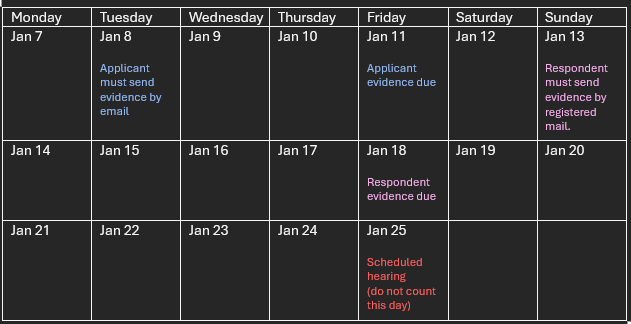
Remember, these are the last dates by which you can send evidence. It is strongly recommended to send evidence as early as possible to ensure that your evidence is received in plenty of time.
Substituted Service
Sometimes it can be difficult to serve the other party, particularly where the tenancy has ended and the tenant did not provide a forwarding address or the landlord has moved. In these cases, parties can apply to the Residential Tenancy Branch (the “RTB”) for an order allowing that person to serve the other party in one of the ways not normally accepted for service.
For this, the applicant will need to fill out an RTB-13 Application for Proof of Service and must be able to demonstrate that the standard service attempts have failed or are not available. For example, registered mail showing that the package was returned and that the other party did not have mail-forwarding set up. The applicant must also have an alternative proposed method of service, such as text message or a different email address. Lastly, the applicant must be able to demonstrate that there is a reasonably likelihood that the person will receive the documents if sent using your proposed method. For example, copies o recent correspondence from that person using your proposed method.
The Deemed Served Rules
Despite these rules, evidence which tends to prove the date of actual receipt may refute the “deemed served rule”. For example, where the person responds to an email the same day it is received, that email is deemed served on the same day it was sent. Similarly, if a tenant was out of the country when a landlord sends documents by registered mail and that tenant picked up the documents upon their return eight days after the documents were sent, the documents are deemed to be served on the eighth day after sending rather than the fifth day. If you know the other party is going to be out of town, it’s a good idea to plan ahead and make sure that your method of service will be received.
Parties should not attempt to avoid service. Often, a landlord or tenant will deliberately not pick up their mail or will decline to respond to an email acknowledging receipt of documents, believing that it will somehow give them an advantage. In reality, there is rarely any advantage gained by avoiding service or pretending not to have received documents. At best, it can harm a party’s credibility when the history of email communications shows that they routinely respond to emails within 24 hours, but suddenly take three days to respond to every email after a dispute is filed. At worst, a party failing to pick up their mail in a timely manner may cause them to miss important information or deadlines and thus lose precious time required to respond. In these cases, the deemed served rule still applies, so the avoidant party only disadvantages themselves.
Keep a copy
Both parties should ensure that they keep an exact copy of every document they served, and every document served to them. Parties must also ensure that an exact copy is uploaded to the RTB, along with any proof of service, such as a copy of the outgoing email or tracking information for registered mail packages.
Generally, it makes matters much easier if each party serves all their evidence in a single package and numbers the entire package with continuous page numbers. Because hearings conducted by phone don’t allow the participants to physically show each other documents, clearly numbered pages make it easy for the parties and, most importantly, the arbitrator, to follow along with your submissions and ensure they are looking at the right documents while you are speaking.
Leading the tribunal through the evidence clearly and competently is vital to your case. Whenever a document is referred to in the hearing, you should clearly identify it by name, date, and page number, then give the arbitrator and the other party a moment to navigate to that document.
For example: “I advised the landlord of the leak in the kitchen sink in my email dated January 8th, which is at page 14 of the evidence package.”
The Bottom Line
The Rules of service are not a means of catching people out. Rather, they are intended to ensure that each party has a fair chance to make a case, or know and meet the case against them. While documents served after the deadlines may be considered by the arbitrator in some cases, arbitrators must first consider any valid reasons for serving the documents late, whether admitting the late evidence would unfairly prejudice the other party, and whether it is in the interest of justice for that evidence to be considered.
For example, if a tenant serves an evidence package containing 2 pages of emails with the landlord one day after the deadline for service in a particularly complex matter, this is unlikely to be prejudicial to the landlord since it would not take the landlord a long time to review two pages, and the landlord was already privy to the documents/information. On the other hand, where a claimant serves a 68-page evidence package 2 days before the hearing, this is highly prejudicial to the respondent who has not had adequate time to review the documents much less respond to them.
Remember, deadlines for service are the last possible date that the other party should receive your evidence. Parties should never wait until the last moment to serve documents as it is rarely helpful, and very often detrimental to their position at the hearing. Further, this often gives the impression that the party is disorganized, does not care about the proceeding, or is underhanded, uncooperative, or deliberately trying to disadvantage the opposing party.
Summary
Service of documents in RTB matters can be complex. With strict rules of service, failing to send documents in a timely manner may prove fatal to a party’s claim or defence. Each party should take care to familiarize themselves with these rules well in advance of the hearing to avoid the possibility of having their entire evidence package being found inadmissible. Similarly, parties should make sure that they send their documents using only permitted methods of service. If in doubt, seeking legal advice early can help you avoid costly mistakes.
Written by: Rachael Walsh